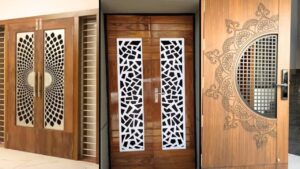
Jali Redesigned The Contemporary Jali Door Design Combines Timeless Style with Tradition

When you hear “jali,” what comes to your mind? For many, it conjures images of sun-soaked Mughal castles and intricately carved stone screens and the romantic ambiance of havelis that date back centuries. It’s a word that is rooted in history, a gorgeous artifact from the past.
But what if we informed you that Jali was not an ancient antique? What if we said that it’s among the most fascinating, flexible, and modern components in the modern interior design playbook?
In the modern world ofhome design for homes, the simple Jali has seen a dramatic transformation. It has been able to shed its “traditional-only” designation and become a modern instrument for architects and interior designers. With the help of new materials, the latest technology, and a new style, the modern Jali door is a masterwork of design and functionality.
Homzinterio Homzinterio Homzinterio, we believe that the most appealing designs are ones that tell a story. The contemporary jali’s story is one of a quaint idea that is timeless. Don’t believe thatJalii is bulky or outdated, or even a bit sloppy. It is now elegant, stylish, and breathtakingly beautiful.
This detailed guide will show the ways in which the modern jali door style has made a huge return in the past few years. You can utilize it to give a “wow” aspect to your home.
The enduring genius of Jali Door
Before we go inintohe “modern,” let’s appreciate the “why.” Jali, that translates to “net” also known as “lattice,” was an architectural marvel designed to serve a specific purpose. The intricate patterns were not just ornaments; they were an innovative, environmentally-friendly solution.
In hot climates, the walls of a solid structure block air, and windows with open spaces invite the sun’s harsh rays and can compromise privacy. Jali screen was able to solve all three issues at once:
- It allowed ventilation, which made it possibleto coolg cross-breezes.
- It dilated the harsh light, transforming its light to create a soft, diffuse glow, while also shielding from the heat.
- It offered security and allowed those who were inside to view out without being able to be clearly observed (the “purdah” idea).
These essential functions are as important tinthe current day. In a city with a lot of people A modern jali entrance will provide privacy, filter light, and create an attractive layer, without making the room feel cramped.
The Modern Makeover: From Hand-Carved to High-Tech
The biggest change has occurred in the process of making jali and the materials it is made of. The time-consuming, laborious method of carving stone or wood is now complementedbyh the accuracy of the latest technology.
The Rise of the Machine: CNC and Laser Cutting
The real game-changer can be found in CNC (Computer Numerical Control) routing. With a CNC machine, you can upload the digital design file–any kind of design you could imagine–and the machine will cut it precisely into a piece of material. This opens up a plethora of possibilities in design: Geometric and Abstract: The most well-known contemporary style. Think straight lines, hexagons, chevrons, ns interlocking circles, or abstract patterns that resemble a work of contemporary art.
- Biophilic: Natural-inspired patterns are on the rise as a trend. You can design delicate, flowing designs of leaves,ves vines, waves, or even leaves that bring the feeling of the outdoors into your home.
- 3D Jali: This is the latest technology. By varying the thickness of the cut, CNC machines can make three-dimensional, sculptural panels that are able to play with shadow and light freshly and innovatively.
The New Material Palette
Although traditional stone and wood are gorgeous, they are also expensive and heavy. Modern jali doors make use ofa more, better, and more flexible selection of materials.
- MDF/HDF (Medium/High-Density Fiberboard) MDF/HDF is the mainstay of contemporary Jali. The engineered wood material,l which is extremely smooth, dense,se and extremely solich makes it the perfect “canvas” for precise CNC cutting. It’s economical and is able to be painted with any high-gloss, matte, or metallic finish that matches your interior decor.
- It is also known as WPC (Wood-Plastic Composite) A solution-oriented material. WPC is completely waterproof and termite-proof. This makes it the ideal material to construct doors to bathrooms, balconies,s or a gate on the exterior.
- Metal (MS, Stainless Steel, Brass) for a hint of elegance, industrial chic, Art Deco glamour. Laser-cut jali doors for metal with finishes like matte black, brushed gold,d or antique brass are stunning.
- Acrylic: For a modern, rn shiny, lustrous, or transparent effect. The acrylic jali panel is extremely light aisare able to be lit backwards to create an intense, futuristic glow.
5 Ways to Use Modern Jali Doors in Your Home
A jali design isn’e just intended for front gates. Its versatility lets it solve design issues throughout the home.
1. The Sacred Space: The Pooja Room Door
This is probably the most well-known and attractive use of contemporary Jali. A pooja space is an oasis of peace, and a jali door can be the ideal threshold. It creates a senseof privacy and sacredness without shutting the room off.
- The Look: A pair of doors with a traditional-yet-modern jali pattern (like a lotus or a ‘mandala’ motif) in a white or wood-grain finish. Most often, bells are built into the handles.
- The purpose: Is to allow the light that emanates from the diya (lamp) to be filtered out and create a tranquil atmosphere within the adjacent room. It also permits ventilation, which is crucial for incense users.
- Homzinterio Tips: For smaller homes, folding doors for the area for pooja is a fantastic space-saving option.
2. The Grand Entrance: The Main Door
Your main door is your home’s first impression. A modern jali entrance makes an unforgettable impression. It gives an incredible “peek-a-boo” effect that gives an impression of the gorgeous home that lies within.
- The look: A solid door made of metal or wood with a jali panel. The panel is usually covered with frosted glass, a mesh of metal, or a transparent polycarbonate sheet.
- The purpose: The backing offers security, blocks out insects, and ensures the privacy of the Jali panel itself is a powerful design element, letting you know who’s out there.
- Homzinterio Tips: Pick an abstract, geometric design with a contrast hue (like the black metal jali in a teak door) to create a bold contemporary statement.
3. The Smart Divider: Jali as Partitions
In the modern open-plan home, the problem is to design “zones” without walls. Jali partitions are the most effective solution to this dilemma. It divides rooms, such as the living room from the dining space, without hindering light flow or a sense of privacy.
- The Style: A floor-to-ceiling jali panel that can be installed or, better yet, designed as a sliding door that slides on an old barn track.
- The Function: It defines the dining area and provides it with a sense of intimacy; however, it also allows for conversations and a visual connection to your living space. It’s an “now you can see it, but it’s not” wall.
- Homzinterio Tip: This is the place where you’ll enjoy the most with patterns. Large-scale biophilic (leafy) pattern will make your partition appear like a live-art installation.
4. The Functional Accent: Wardrobe & Cabinet Shutters
This is cleverve,r practical trend that we are seeing growing in popularity. The use of jali on the cabinet doors is stylish and practical.
- The Style: Jali panels on wardrobe doors, shelves,k s as well as media racks.
- The Function: Ventilation! Jali shutters on an armoire (especially one designed for linen) or a cabinet for shoes are an amazing way to allow air to circulate aeliminateing smelly musty smells. For a media device, the jali panel could effectively hide the wires and the set-top box and still allow the remote control’s signal to go through.
- Homzinterio Tip: We like the look of a rattan or cane pattern of jali on wardrobe shutters for a soft, airy, “boho-chic” aesthetic.
5. The “Wow” Factor: Backlit Jali
This is how you transform a jali panel, being a design element,t into artwork. By installing LED strip lights in the middle of the jali panel, whether it’s a door, partition, or an artwork, you create a stunning design.
- The Style: Light flows through the cut-outs, accentuating the intricate pattern and casting striking shadows. The result is calmin,g luxurious, five-star hotel lobby.
- The function: It acts as a source of light as well as a design centerpiece. It’s ideal for a focal wall in the living area or a headboard for bedrooms.
The Homzinterio Difference: Jali, Integrated Your Way
A contemporary jali door isn’t an individual item that you purchase from a shop. It’s a custom-designed element that has to be able to communicate in the same language as the rest of your home. This is why expertise in design is essential.
- Cohesion: The pattern you select for your pooja area should match the style of the modular kitchen. The metal jali you choose for your partition should match the cabinet hardware. The design of your jali is seamless, not an added touch.
- Customization: Our process is based on design. This means that you can’t simply choose from a catalogue. We can create an individual CNC pattern for you. Do you have a favorite design? Are you looking to abstract your family’s initials? We can turn your dream into a digital image and make it come to life.
- Smart Materials: we advise you on deciding what materials to use in which places. We’ll suggest moisture-proof WPC for your balcony’s screen as well as a strong MDF that is paintable in your bedroom, or a highly-impact clear acrylic jali that is easy to clean to create a partition for your child’s room.
The door of the jali is, for many reasons, the ideal emblem of contemporary Indian design. It’s rooted in a rich and sophisticated tradition, yet it has evolved, adapted, and taken on technology to make it more modern than ever before.
It’s a partition, a door, an air vent, a light diffuser, and an object of art in one. It’s a means to play with shadows, light,t and space. No matter if your house is modern, minimal, st or traditional, as well as the other way around, there’s the latest jali design to make it look better.
Are you ready to discover the art of modern Ji in your own home?
Createstunningn, ing functional, light-filled, and functional spaces. Speakao an Homzinterio designer now, and let us create an exclusive jali design that will tell your story.
FAQ
1. What is the major difference between modern and traditional Jali doors?
The primary difference is in the raw materials used and the manufacturing process. Traditional jali was usually hand-carved out of heavy stone or wood, creating traditional, intricate designs. Contemporary jali is mainly made with CNC (Computer Numerical Control) or laser cutting using materials such as MDF/HDF, WPC, and acrylic.
2. Does Jali work well in smaller-sized and compact pooja rooms?
Yes, absolutely. Modern Jali doors are highly recommended for smaller areas. The article points out that a door made of jali can give an impression of sanctity and separation without completely securing the room, thus avoiding the “boxed-in” sense.
3. What material is the best choice for a jali door when it is in humid areas like an outdoor balcony or bathroom?
In areas where there are humid conditions, like an exterior gate, balcony,y or in a moist location, the best choice to use is WPC (Wood-Plastic Composite).
4. How can a jali door in a wardrobe or a cabinet aid in function?
The use of jali on wardrobes or cabinet shutters is an excellent design choice as it allows vital ventilation. The cut-outs let air circulate, which eliminates odors that smell musty, ty particularly in cabinetry for shoes or linens. In the case of a media device, the ice the jali can be useful as it hides the wires and set-top box and still allow that remote’s signals be transmitted through.
5. If I have a tiny apartment for a pooja space, do I need to select either a folding or sliding Jali door?
In s for pooja rooms, doors that foldares typically the best option, particularly if your area of the pooja is recessible or has a niche. The doors fold well towards the side, which takes up a tiny wall space.